
Arugula in the US, rocket in Europe, and roka in Greece: all of these are different words for the same wonderfully peppery green, ubiquitous to the Mediterranean diet and longevity cooking. Historically, it’s also found in plenty of dishes across Africa, Asia, and the Middle East. Arugula is a nutrient-dense food high in fiber and phytochemicals; calcium for bone health and nerve and muscle function; potassium for reducing sodium’s negative effects; and vitamin C, an antioxidant that helps support the immune system.
And now, for a little science! Did you know that arugula is actually part of the Brassica family, including broccoli, cabbage, mustard, and watercress? And the flavor can range from eye-wateringly spicy to slightly radishy: it all depends on the isothiocyanates, the chemical compounds that the leaves produce. When they’re growing, isothiocyanates defend the plants from diseases and hungry insects, but when eaten, the plant gets its many health benefits from isothiocyanates.
As far as the differences in that characteristic peppery taste, it all depends on where arugula is grown. Temperature plays a big role in the amount of isothiocyanates that the leaves release – most likely, this is a stress response by the plants, and it means that warmer countries (like Greece) generally produce spicier leaves than those in the US.
This gorgeous green has hit its stride in the US in recent years, and is now on supermarket shelves everywhere – but it has been an integral part of the Greek diet for centuries. On the regional Greek table, we cook it with black-eyed peas and other legumes, but when springtime hits in full force, we typically enjoy it raw in salads.
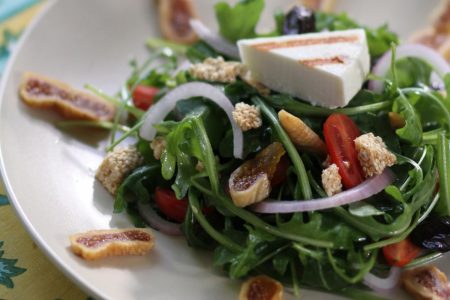
Indeed, in the Greek diet, no meal is complete without a salad, and when arugula starts to spring its tender, peppery leaves from the garden, as mine is now in Ikaria, we pluck them and toss them with a whole bevy of other delicious Mediterranean diet foods.
Arugula pairs well with almost everything that’s basic to the healthy Greek diet: nuts, herbs, a range of fruits, sheep’s milk cheeses, and, of course, the most foundational Mediterranean diet ingredient of all, extra virgin olive oil.
Below, I’ve listed a few arugula salad recipes that include plenty of other Mediterranean diet ingredients highlighting the best of spring in Greece!
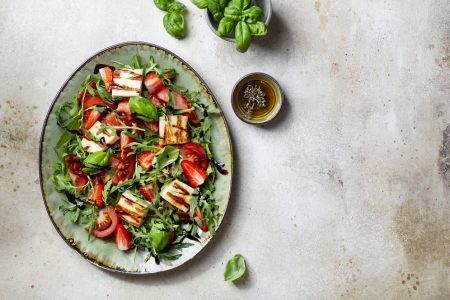
Arugula strawberry salad with grilled haloumi
Arugula salad with dried figs, wrinkled olives, and pasteli
Arugula salad with grilled pears and grilled haloumi
Arugula, fennel, pomegranate, and olive oil salad
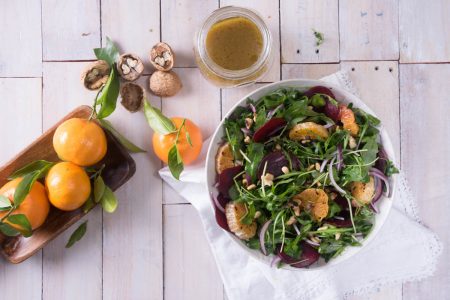
Warm roasted beet and tangerine salad with arugula, walnuts, and red onions