
Happy International Women’s Day! Commemoration is in order and from my perspective that inevitably means the place of women in the kitchen. There are countless unsung female heroes in professional kitchens throughout Greece, mothers, grandmothers and aunts who help out in their kids’ restaurants, in the family business, or as employees of others, typically there to make all the traditional foods. Of course, there are numerous very well-known and respected women chefs, among them Nena Ismirnoglou, Argyro Barbarigou and Georgiana Hiliadaki, to name but three in Greece.
But I would like to devote these words to the women who aren’t on the line in restaurant kitchens but rather for whom food was the source of another kind of power, familial, not professional. I’ve spent a good part of my working life researching the regional foods of Greece, traveling to remote places, scouring markets, meeting home cooks, almost always women. There are common threads among them all. For one, most village cooks have a profound sense of food that comes less from knowing actual recipes and more from their relationship to the earth, to gardening and foraging. They know the seasons and what is meant to be in each, from the wild foods that sprout for the picking to the abundance that needs to be preserved. Oftentimes, this knowledge is almost instinctive, a living tradition not easily put into words.
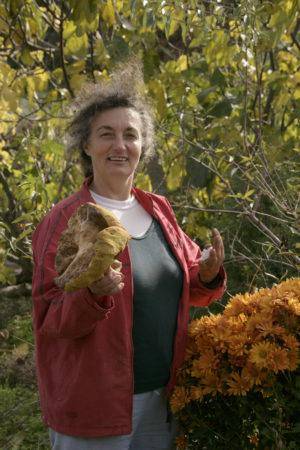
Take my friend Argyro, on Ikaria, for example. She is a simple (and very good) cook whose food is completely rooted in whatever is available locally. She’s been picking wild foods since she was a girl and rarely gave much thought, let alone expression, to all that she knows. I sat with her on several occasions to document the wild greens and mushrooms of Ikaria and have gone foraging with her on the island, always awestruck. It was a beautiful moment when she saw that my notes had gone on for about two dozen pages, all filled with what she had nonchalantly rolled off her tongue, a veritable catalogue of the flora on the north side of Ikaria, replete with usages and recipes for each. A lot of that information is now housed happily in the pages of a book (Ikaria: Lessons on Food, Life and Longevity from the Greek Island Where People Forget to Die).
One of the treasure troves of Greek cooking is to be found in the meticulous handwritten recipe books filled with family dishes passed down from one generation to the other. These beautiful old notebooks, inked in calligraphic hand, were essentially a tradition among urban, bourgeois home cooks, who were learned enough to write. One of the ironies of these books, however, is that the written recipe alone could never suffice to reproduce the dishes that they were meant to record. That was only possible with experience, starting at a very young age at the side of other women in the kitchen, mothers, grandmothers, a beloved aunt, etc. The words were a road map but the execution required empiric knowledge and taste memories, the world, in other words, of tradition guarded closely by home cooks.
In my experience, traditional Greek home cooks rarely share a recipe in its entirety! They will gladly share the last crumb in their larder, the last nut on the table, the last piece of a savory pie, but ask them for the recipe and what results is an approximation, born partially of a lack of method for documenting recipes with real accuracy, but mostly born of a sense of privacy and power derived from the knowledge of how to make the dishes that the family loves, the dishes that draw – and keep — the family together. In a patriarchal society like Greece, traditional women had (and have) power in very limited places within the family structure. The kitchen has always been one of them. Sharing actual recipes so that someone else could reproduce their food meant forfeiting some measure of their power, diluting it.
They were and still are the keepers of culinary traditions.
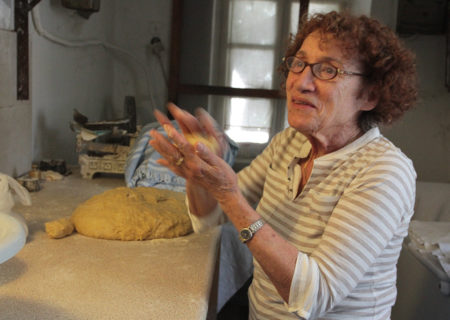
One of the most beautiful experiences in Greece is to cook with other women for the holidays or festive occasions. On Crete, for example, no wedding is complete without the days of baking decorative, symbolic breads and other confections that are part of the wedding rituals. In my small village on Ikaria, women gather every Holy Week to share in the making of Easter cookies (koulourakia) and breads (tsoureki). When I got married, my mother-in-law and her cousins hand-rolled about a thousand dolmades and fried a few thousand meatballs, all part of the camaraderie of women who cook.
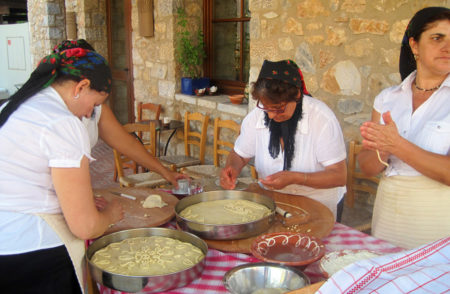
Power came from the appreciation of those efforts and the knowledge of how to make the foods that speak of Greekness, the foods that provided the necessary backdrop to all social interaction, familial and otherwise. Maintaining the traditions was – and is – akin to preserving a deep cultural heritage, one that ultimately defines us as Greeks. An important job, I’d say…